
Kids today can open an app and stream an entire anime season before dinner. In the early ’90s, getting your hands on anime in the Philippines was a hunt. Sometimes it was a luxury. And sometimes you just got lucky.
Before the VCD stalls of Quiapo, before Greenhills turned into the pirated disc capital of the country, there were Betamax tapes, VHS tapes, and a lot of saving up. This is how a Pinoy kid got anime back then.
Anime Was a Luxury
Let’s be honest. In the early ’90s, anime was a luxury for most Filipinos.
Free TV gave us what it could. After People Power, anime returned to local channels, and Tagalog dubs started to take off around 1990. But what aired was limited to whatever the networks bought. If you wanted more, you needed money.
The lucky ones had cable. A subscription to Sky Cable could get you anime that never aired on Filipino television. For the rest of us, that was something you heard about from a classmate, never something you saw at home.
The big ones for me were the Takara Transformers anime: Transformers: The Headmasters and Transformers: Victory. These were the Japan-only continuations of the Transformers story. They never aired on American TV, and for most of the world they didn’t exist. In Asia, they reached us through Star TV, the Hong Kong-based satellite network, under the label “Transformers Takara,” with an English dub that’s still famous among fans for how wild it was.
For Filipino kids who grew up on the American cartoon and Transformers: The Movie, this was a whole new world. New Autobots, new Decepticons, Headmasters with little partners that turned into robot heads, and Star Saber in Victory. If you had cable, you were watching Transformers that your classmates had never heard of.
We caught an episode of Victory on Star TV with our cousin, and I still remember it. One episode was enough to show me there was a whole world of anime out there that free TV wasn’t giving us.
The Betamax Rental Lottery
For most of us, the real gateway was the neighborhood Betamax and VHS rental shop.
Back then, renting a tape was part of the weekend routine, and every neighborhood had its own shop. Most of the shelves were Hollywood movies, local action films, and the latest bold films that we weren’t supposed to look at. But every now and then, you’d find something that didn’t belong.
A random Dragon Ball Z movie. An OVA you’d never heard of. Usually it was in the original Japanese audio with no subtitles, or dubbed in some other foreign language. You couldn’t understand a word, but you didn’t care. It was anime, and it wasn’t on TV.
I was lucky. I lived near a few of these shops: one on Banawe St., and others on Mayon St. and Dapitan St. One of them had a Betamax tape of Tenchi Muyo! Ryo-Ohki, the original OVA, with two English-dubbed episodes on it, including “Hello Baby!” For a kid in Quezon City, that tape was a treasure.
The P500 Tape
If you had the funds, you could go official.
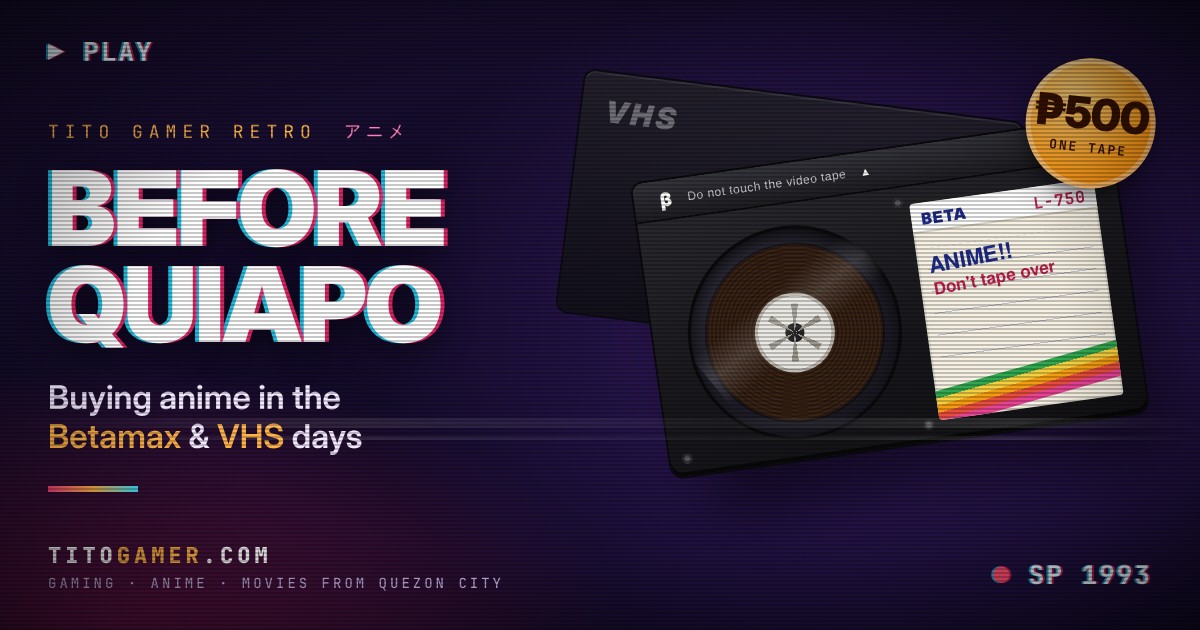
Viz Video released anime series on VHS in the States, and you could order one through a shop on the first floor of Virra Mall. You picked your tape, paid, and waited about a week for it to arrive. The price was around P500 a piece.
For an elementary kid, P500 was an incredibly rare amount of money. That was birthday money. That was Christmas money. You didn’t just have P500 lying around. You got it maybe once or twice a year, if your Titos and Titas were feeling generous.
I saved up and bought one: a Ranma 1/2 tape from the Hard Battle series, the one with Shampoo on the cover, “Soap Gets in Your Eyes.” That orange Viz logo in the corner and the line at the bottom, “Japanese Animation… in English!”, felt like proof that I owned the real thing.
And that was it. Just the one tape. Because it was such a luxury, I could never save up enough to buy a second one. I watched that single tape over and over.
The Bootleg Escape Hatch
Then came the bootlegs.
Bootleg anime VHS tapes were much cheaper than ordering an original. They looked rough, and sometimes the picture had that washed-out look you get from a copy of a copy. But for a kid on a budget, they meant you could finally own more than one tape.
My biggest score was a copy of Gundam Wing: Endless Waltz for only P250, from a little Filbar’s stall underneath an escalator in Virra Mall. Half the price of my Ranma tape, and it was Endless Waltz.
Here’s the crazy part: it had English subtitles. Nothing on the tape said so. With bootlegs, you never knew what you were getting. It could be raw Japanese with no subtitles, or dubbed in some other foreign language. I popped it in expecting to understand nothing at all, and there they were: clean English subtitles under Heero and the gang. For a bootleg, that was hitting the jackpot.
Little did we know, that stall under the escalator was a preview of what was coming. By the late ’90s, Greenhills would become known as the country’s biggest haven for pirated material, and VCDs would replace tapes entirely.
It Wasn’t Just the Bootleggers
The government had already been trying to clean up the video business for a long time. In 1985, Presidential Decree 1987 created the Videogram Regulatory Board. Every rental shop had to register with it, along with every single tape on its shelves, and there was a 30% tax on tape sales and rentals. When the Supreme Court upheld the law in 1987, it pointed to “rampant film piracy” as one of the reasons the industry needed regulating.
So the bootleg anime tape was never really a secret. It was part of a gray market that had been around since the Betamax days. The Virra Mall stalls just made it easier for an anime fan to find.
Why It Mattered
Looking back, those tapes meant more than the anime on them.
When something is hard to get, you treasure it. One Ranma tape was a whole collection. A Tenchi Muyo rental was an event. A P250 Endless Waltz bootleg was a victory. We didn’t binge. We rewatched, and we remembered every scene.
Today I can stream all of Ranma 1/2 in an afternoon. But I’ll never forget the tape that cost me P500 and a lot of saving.
Your turn, Titos and Titas: What was your first anime tape? Did you have a suki rental shop that carried anime? Did you ever buy a bootleg under an escalator? Tell me in the comments. I might feature your stories in a follow-up post.
Next on Tito Gamer: When VCDs arrived and the Quiapo stalls took over.