Tag: Piracy

  • The Bootleg Family Computer Era in Quezon City

    The Bootleg Family Computer Era in Quezon City

    Growing up in Quezon City from the late ’80s through the ’90s, I knew the Family Computer long before I could name any other game console. The first rentahan I tried had Super Mario Bros. 3, Ice Climber, and Balloon Fight, but I went with Pac-Man on its Nintendo Entertainment System, or NES. Later, I found more Family Computer games on the third floor of Virra Mall in Greenhills, one of the stops in my story about Metro Manila’s video game rentals.

    Bootleg consoles and cartridges helped keep Nintendo’s 8-bit games popular in the Philippines. A console at your cousin’s house could have a different name on the case and still take the same cartridges. A 1000-in-1 cart could put Contra and Duck Hunt on the same menu, ready for you to switch from the gamepad to the light gun. If it played the games we knew, we called it a Family Computer.

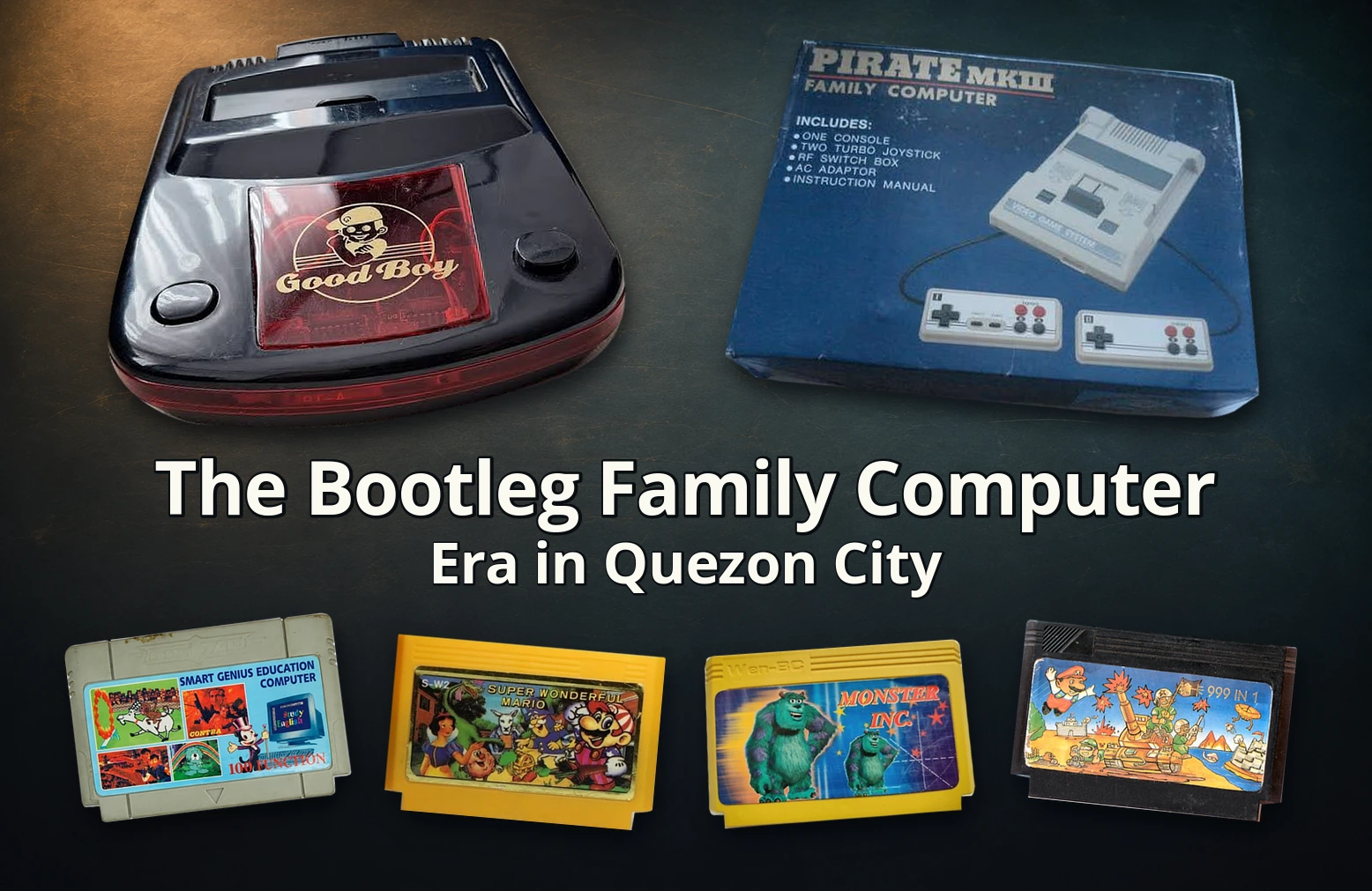
    Black 999-in-1 Famicom cartridge with a worn label showing Mario, a cartoon tank, and soldiers.

    The Original Nintendo Family Computer

    Nintendo released the Family Computer, or Famicom, in Japan on July 15, 1983. Its first three games were Donkey Kong, Donkey Kong Jr., and Popeye, so Japanese kids who knew them from the arcade could now play them on the TV at home. Most of the kids I knew in Manila met these games on the console instead, since there were no Nintendo arcades around in the late ’80s.

    The Famicom had a cream-and-red case, with a cartridge slot on top and a place along each side to tuck away a controller. Both controllers were wired into the console, and the second one even had a built-in microphone with its own volume slider.

    When Nintendo brought the system to North America in 1985, it renamed it the Nintendo Entertainment System. The original North American NES was a gray box with a flap on the front for loading cartridges, and its controllers plugged into ports instead of being wired in. In the Philippines, though, it was the cream-and-red Famicom that many lookalikes were made to resemble.

    Yellow bootleg cartridge labeled “Monster Inc.” with two pictures of Sulley.

    The Games We Had at Home

    The first Family Computer game we owned was Tetsuwan Atom, starring the robot boy we knew as Astro Boy from Osamu Tezuka’s manga and anime. Konami released it for the Famicom in Japan in 1988, and it never got an official Western release.

    When Dad came back from Japan, he brought us Super Mario Bros. and Top Rider. The racing game came with a yellow-and-blue inflatable motorcycle and a foot pump. Its white handlebar controller mounted on the bike and plugged into the Family Computer. Once everything was set up, you could sit on the inflatable bike and steer the one on the TV.

    Why the Clones Got the Same Name

    A Famiclone was an unofficial console built to play Famicom games. Some copied Nintendo’s cream-and-red case outright. Others looked nothing like it: the Game Engine resembled a 16-bit Super Famicom but played the older 8-bit games.

    What many of them shared was the same 60-pin cartridge slot as the Japanese Famicom, so the same cart worked no matter whose brand was on the case. That’s why, to us, they were all Family Computers.

    The gray North American NES was a different story. It took wider, 72-pin cartridges, so Famicom carts didn’t fit on their own. Some Filipino NES owners bought adapters to play the smaller Famicom carts, since games imported from the U.S. cost more.

    Blue Pirate MK III Family Computer box showing a light gray console and two wired controllers.

    Where the Clones Came From

    Taiwanese manufacturer TXC sold its Micro Genius consoles across Southeast Asia, and a trade survey put its output at about 100,000 units a month in 1992. One Micro Genius model, the IQ-501, had a power light and a spring-assisted ejector that popped the cartridge up when you moved a lever. It often came bundled with a multicart, so you had a menu of games to try as soon as you opened the box.

    Not every clone was put together in Taiwan, though. Taiwanese suppliers also shipped circuit boards and chips abroad for assembly, and a 1994 filing on behalf of Nintendo and its licensees named the Philippines as one of the places where those components were assembled.

    Where We Found Them in Metro Manila

    Famiclones weren’t just sold in the alley shops of Recto or in Virra Mall. You could find them all over Metro Manila, even in SM department stores.

    One of them was a Hanabishi Family Computer, from the same Philippine brand that got its start selling electric fans. Some of its controllers had orange Turbo buttons above A and B. Hold down Turbo B in Contra, and you could keep firing without tapping B for every shot.

    Gray Smart Genius Education Computer cartridge with Contra artwork and a label that reads “100 Function.”

    A Hundred Games on One Cartridge

    Bootleg cartridges were as much a part of the Family Computer era as the clone consoles. Multicarts were everywhere, and a single 100-in-1 could hold most of the Famicom’s launch lineup. One put Popeye and Donkey Kong, two of Nintendo’s three launch titles, on the same menu as Contra and Duck Hunt, with Donkey Kong listed as King Kong I.

    Around Divisoria Mall, shops sold 50-in-1 and 1000-in-1 cartridges with games like Mappy and Battle City. A familiar name on the label could also hide a different game. One bootleg called Super Mario IV was really a game called Armadillo with Mario swapped in. He still rolled into a ball to attack, just like the armadillo he replaced.

    Some electronics stalls still sell these bootlegs today.

    Yellow Super Wonderful Mario cartridge with Mario and Snow White on the label.

    Why Pinoys Missed Out on Zelda and Metroid

    Cheap Famiclones and multicarts gave us plenty to play, but games that rely on battery saves like The Legend of Zelda and Metroid were hard to come by where I grew up in Quezon City. Part of the reason was saving. Both games first came out in Japan on the Famicom Disk System, an add-on that saved your progress to the disk.

    On the NES, the cartridge versions needed another way to remember where you left off. Zelda’s cartridge had a small battery inside that kept your save intact after you switched off the console, so you could clear a dungeon one day and pick up the adventure the next. Metroid gave you a password when your game ended instead, and you had to copy it down and enter it the next time you played to get your upgrades back.

    Many of the bootleg multicarts we could buy came without battery backup, so they couldn’t hold onto a Zelda save.

    I got lucky when my cousin lent me their NES copies of The Legend of Zelda and Super Mario Bros. 2. Those cartridges were too wide for our Family Computer, but Dad had brought home an NES-to-Famicom adapter. I plugged each game into the adapter and fit the whole thing into our console, and that’s how I finally got to play both games at home.

    Black and red Good Boy Famiclone with a top-loading cartridge slot and a gold logo.

    The Family Computer We Remember

    Looking back, it never mattered much which company made the console. Nintendo built the Famicom, but in Metro Manila, the Family Computer was whatever sat under your TV. It might be a Micro Genius from Taiwan, a Hanabishi with orange Turbo buttons, or a no-name box from Recto.

    The clones and multicarts weren’t official, but they’re the reason so many of us grew up with Mario, Contra, and Duck Hunt at all. They had their limits: the cheap carts couldn’t hold a Zelda save, and some games only reached us through a cousin’s NES and Dad’s adapter. Still, between the rentahan, the shops of Virra Mall and Divisoria, and whatever Dad brought home from Japan, we always found something to play.

    Some electronics stalls still sell those bootleg carts today. Whatever name is printed on the case, if it plays the games we knew, it’s still a Family Computer.
  • PS5 Piracy: The Return of Sony’s Old Problems

    PS5 Piracy: The Return of Sony’s Old Problems

    PS5 piracy is gaining attention at an awkward time for Sony. The company is preparing to end new physical game releases, while recent jailbreak developments have renewed concerns about unauthorised copies. For players already frustrated about losing discs, the news has become another reason to question where PlayStation is heading.

    Sony has faced this problem before. Piracy hurt the PSP’s software business, and the effort to prevent a repeat helped shape the restrictions surrounding the PS Vita. Now, Sony faces a familiar challenge with the PS5: protecting game sales while giving customers good reasons to keep paying. I think that second part matters more than Sony might admit. PlayStation built its appeal on performance, convenience and value. Those advantages need to survive its digital future.

    PS5 Piracy Has Put Sony Back in Familiar Territory

    Sony has been here before. Hackers find a way into a PlayStation, unofficial software follows, and Sony responds with updates. The latest PS5 jailbreak developments add another ingredient to that familiar struggle: AI-assisted research.

    Where AI Fits Into the PS5 Jailbreak Story

    Polygon links the recent pace of PS5 homebrew development to advances in AI code-generation tools. However, that does not establish that someone asked an AI to crack the console and received a finished jailbreak. The evidence supports a more specific account of researchers using AI assistance during their work.

    Researcher Jordy offered one example during a dispute over a PS5 hypervisor vulnerability, which concerns a security layer protecting the system. He said another person found the same bug using AI, after he had initially agreed to withhold his report to Sony. This is a researcher’s account of AI-assisted discovery, rather than a published explanation of exactly which tools performed each task.

    What the Public Relapse Jailbreak Actually Does

    The publicly documented Relapse jailbreak supports PS5 firmware versions 7.00 through 13.60. Its developers describe a chain that combines a weakness in the console’s browser software with a second exploit targeting the kernel, a central part of the operating system. Together, those stages provide access beyond what Sony normally permits.

    That access creates room for unofficial software and homebrew development. It also brings instability: the project warns that attempts can stall or crash the console. Its documentation credits several human researchers and developers, including Jordy, Sonic_Iso, ntfargo and ufm42. Calling the entire release an AI-created jailbreak would overlook those contributions.

    The Latest Update: Prolapse Claims and Firmware 14.20

    As of 24 October 2026, attention has shifted to a forthcoming jailbreak called Prolapse. The Pirat_Nation post reports that it is coming to firmware 14.00 and 14.10. Scene figure Jose Coixao, known as zecoxao, also posted that Prolapse was coming to those versions. These are announcements of expected support, rather than proof of a completed public release.

    Meanwhile, Sony’s latest official system software is 26.07-14.20.00. Its published notes list improvements to messages and screen usability without identifying specific security vulnerabilities. Those notes alone cannot establish which reported exploits the update blocks.

    The distinction matters. A released jailbreak, a private demonstration and a promised exploit represent different stages of progress. The developments above show renewed pressure on Sony’s security, but they do not establish that every updated PS5 can now run pirated games.

    Sony’s Digital Success Has Put Physical Games on Borrowed Time

    PlayStation has become so successful at selling games digitally that Sony is preparing to remove the physical alternative. For players who still collect discs, that success comes with an unwelcome deadline.

    Sony plans to stop producing physical discs for new PlayStation releases from January 2028. Its explanation centres on changing buying habits: digital purchases now significantly outpace physical sales. The announcement does not affect games released on disc before that deadline.

    The numbers help explain Sony’s confidence. In the financial year ending March 2026, 78% of full-game software units sold across PS4 and PS5 were digital downloads. That measures game sales, rather than the percentage of players who have abandoned discs. Still, it shows how firmly digital purchasing has become established within PlayStation’s business. Sony no longer needs to persuade most customers to download their games. They already do.

    Ken Kutaragi, the former PlayStation executive who oversaw the first three consoles, sees an economic argument for the change. Speaking to VGC, he questioned whether continuing to dedicate resources to physical media remained economically reasonable. He compared modern consoles with connected devices such as smartphones, where customers generally expect to retain access to their content without a physical copy. However, he also acknowledged that Sony’s approach had created friction with gaming enthusiasts. These were his views as a former executive, rather than an official explanation from Sony’s current leadership.

    From a business perspective, the appeal is understandable. Digital distribution removes the need to manufacture, package and ship a disc for each copy. The broader argument is that Sony’s successful digital business makes withdrawing that option easier to justify. But a customer choosing a download for one purchase has not necessarily agreed to lose physical releases altogether.

    That is where Sony risks misreading its own success. Players can appreciate digital convenience while still wanting cheaper used copies, something to lend a friend, or a collection sitting on a shelf. Strong download sales explain why Sony wants to move on. They do not settle whether its customers should have to.

    The PSP Shows What Piracy Could Cost Sony Again

    Sony’s history with piracy offers a warning for the PS5: a console can attract enthusiastic players without generating the game sales needed to sustain developer support.

    The PSP’s Popularity Did Not Always Translate Into Game Sales

    Farrel Nobel’s retrospective, How Piracy Ruined PSP, captures that contradiction. He describes downloading numerous games while admitting that, without piracy, his collection would have been much smaller. His experience illustrates the gap between playing games and purchasing them, although it cannot establish how many downloads replaced potential sales.

    Sony expressed similar concerns. In a 2012 Wired interview, Shuhei Yoshida said piracy was “really, really killing the software business” on PSP. Disappointing sales encouraged publishers to invest elsewhere. However, he also acknowledged that Sony weakened support by moving development resources towards the PS3. Piracy compounded the handheld’s problems rather than explaining every setback.

    The Vita Made Paying Customers Bear the Cost of Control

    Sony’s response carried into its next handheld. The company defended the PS Vita’s proprietary memory cards partly on security grounds, while their high prices drew criticism from customers. Measures designed to protect software revenue added another expense to buying the console.

    That history reveals another potential cost of piracy: the restrictions introduced to stop it can make legitimate ownership less appealing. It does not establish that piracy killed the Vita. Instead, it shows how Sony’s determination to avoid another PSP piracy problem influenced decisions that frustrated paying customers.

    PS5 Piracy Could Put Revenue and Future Investment at Risk

    For the PS5, the immediate commercial risk is that unauthorised copies could replace some paid purchases. If that happened at sufficient scale, Sony and publishers could earn less from releases, potentially affecting future investment. Smaller developers could be particularly exposed when a modest number of sales determines whether a project recovers its costs.

    However, a jailbreak’s existence alone cannot reveal the size of those losses. Its reach, reliability and compatibility with newer games all matter. A technical breakthrough creates a potential threat, but it does not automatically produce a repeat of the PSP’s software struggles.

    Sony’s Next Console Could Bring Tighter Restrictions

    The effects could extend to Sony’s future consoles. More spending on security, tighter software controls and stronger account checks are plausible responses, though these remain possibilities rather than confirmed plans for the next PlayStation.

    Sony needs publishers to trust that their games can sell, while customers need confidence that buying those games remains worthwhile. The PSP offers a warning about weak software returns. The Vita offers another about making paying customers bear the cost of control. Repeating either mistake could damage the relationship Sony needs to carry into its next generation.

    Sony Risks Losing the Value That Made PlayStation Worth Buying

    I don’t think Sony’s success comes from exclusive games alone. God of War might convince someone to buy a PlayStation, but the hardware’s value gives them another reason to stay.

    For me, PlayStation’s appeal has always been access to high-end gaming without the expense or effort of building a gaming PC. Depending on the game and settings, the PS5 can deliver an experience comparable to a mid-range or stronger PC setup. You buy the console, install your games and start playing. That balance of performance, price and convenience matters just as much as the names on the game boxes.

    PS Plus adds to that appeal. Its combination of games, online multiplayer and other membership benefits gives players another reason to remain within PlayStation’s ecosystem. I see that service as part of Sony’s competitive advantage. The console gets people through the door, while the games and services encourage them to keep spending.

    Piracy could weaken that arrangement, particularly for players who mainly want access to single-player games. If they can obtain those games without paying, buying individual releases or subscribing primarily for a game catalogue becomes harder to justify. Official online access and convenience still have value, so piracy would not replace everything Sony offers.

    That is where Sony’s growing dependence on digital purchases becomes a concern. Selling the hardware is only part of the relationship. Sony needs customers to keep choosing its games and services afterwards. If piracy weakens that spending while Sony removes purchasing options people value, it risks undermining the reasons those customers supported PlayStation in the first place.

New Report

Close