Growing up in Quezon City from the late ’80s through the ’90s, I knew the Family Computer long before I could name any other game console. The first rentahan I tried had Super Mario Bros. 3, Ice Climber, and Balloon Fight, but I went with Pac-Man on its Nintendo Entertainment System, or NES. Later, I found more Family Computer games on the third floor of Virra Mall in Greenhills, one of the stops in my story about Metro Manila’s video game rentals.
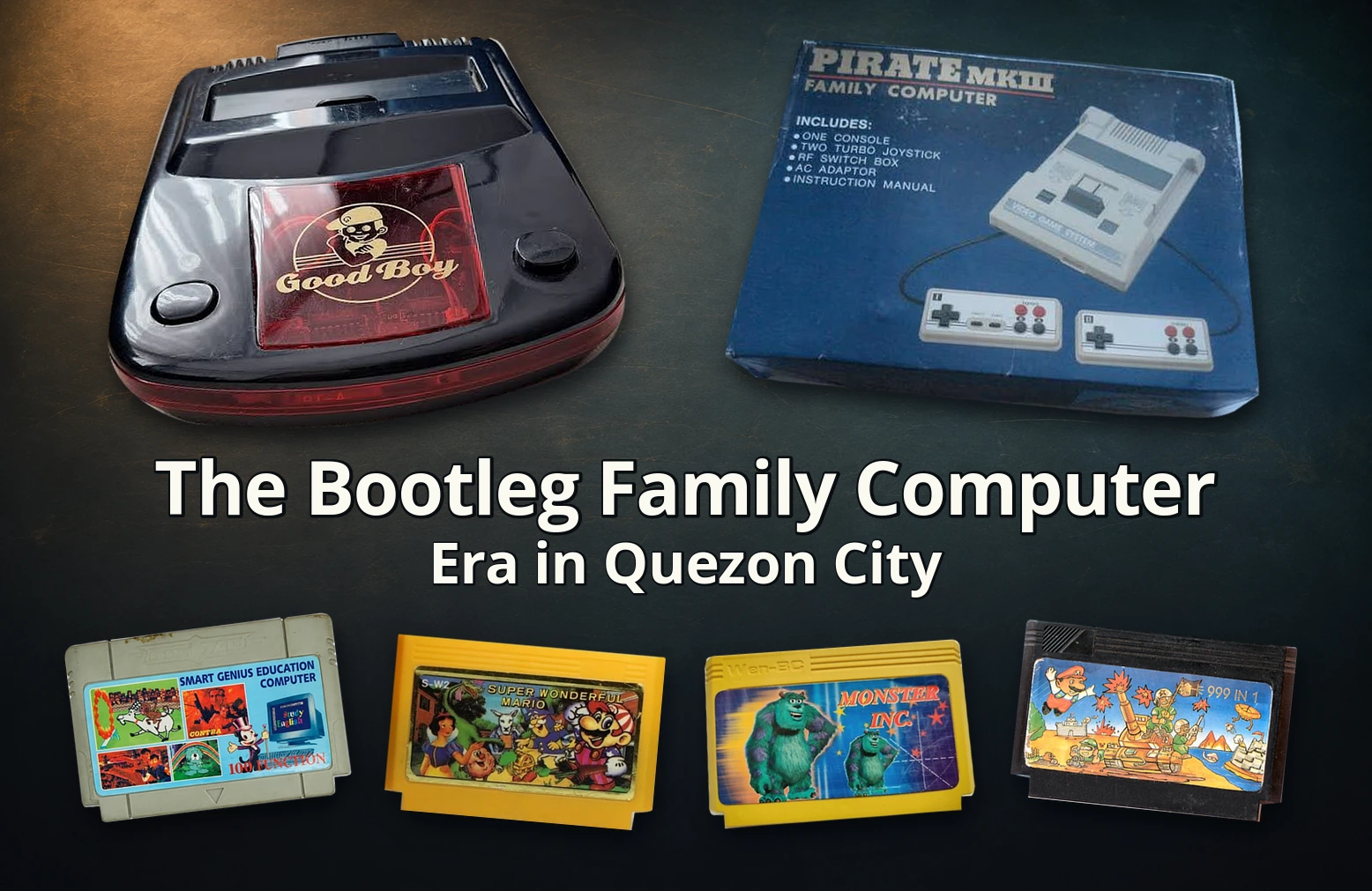
Bootleg consoles and cartridges helped keep Nintendo’s 8-bit games popular in the Philippines. A console at your cousin’s house could have a different name on the case and still take the same cartridges. A 1000-in-1 cart could put Contra and Duck Hunt on the same menu, ready for you to switch from the gamepad to the light gun. If it played the games we knew, we called it a Family Computer.

The Original Nintendo Family Computer
Nintendo released the Family Computer, or Famicom, in Japan on July 15, 1983. Its first three games were Donkey Kong, Donkey Kong Jr., and Popeye, so Japanese kids who knew them from the arcade could now play them on the TV at home. Most of the kids I knew in Manila met these games on the console instead, since there were no Nintendo arcades around in the late ’80s.
The Famicom had a cream-and-red case, with a cartridge slot on top and a place along each side to tuck away a controller. Both controllers were wired into the console, and the second one even had a built-in microphone with its own volume slider.
When Nintendo brought the system to North America in 1985, it renamed it the Nintendo Entertainment System. The original North American NES was a gray box with a flap on the front for loading cartridges, and its controllers plugged into ports instead of being wired in. In the Philippines, though, it was the cream-and-red Famicom that many lookalikes were made to resemble.

The Games We Had at Home
The first Family Computer game we owned was Tetsuwan Atom, starring the robot boy we knew as Astro Boy from Osamu Tezuka’s manga and anime. Konami released it for the Famicom in Japan in 1988, and it never got an official Western release.
When Dad came back from Japan, he brought us Super Mario Bros. and Top Rider. The racing game came with a yellow-and-blue inflatable motorcycle and a foot pump. Its white handlebar controller mounted on the bike and plugged into the Family Computer. Once everything was set up, you could sit on the inflatable bike and steer the one on the TV.
Why the Clones Got the Same Name
A Famiclone was an unofficial console built to play Famicom games. Some copied Nintendo’s cream-and-red case outright. Others looked nothing like it: the Game Engine resembled a 16-bit Super Famicom but played the older 8-bit games.
What many of them shared was the same 60-pin cartridge slot as the Japanese Famicom, so the same cart worked no matter whose brand was on the case. That’s why, to us, they were all Family Computers.
The gray North American NES was a different story. It took wider, 72-pin cartridges, so Famicom carts didn’t fit on their own. Some Filipino NES owners bought adapters to play the smaller Famicom carts, since games imported from the U.S. cost more.

Where the Clones Came From
Taiwanese manufacturer TXC sold its Micro Genius consoles across Southeast Asia, and a trade survey put its output at about 100,000 units a month in 1992. One Micro Genius model, the IQ-501, had a power light and a spring-assisted ejector that popped the cartridge up when you moved a lever. It often came bundled with a multicart, so you had a menu of games to try as soon as you opened the box.
Not every clone was put together in Taiwan, though. Taiwanese suppliers also shipped circuit boards and chips abroad for assembly, and a 1994 filing on behalf of Nintendo and its licensees named the Philippines as one of the places where those components were assembled.
Where We Found Them in Metro Manila
Famiclones weren’t just sold in the alley shops of Recto or in Virra Mall. You could find them all over Metro Manila, even in SM department stores.
One of them was a Hanabishi Family Computer, from the same Philippine brand that got its start selling electric fans. Some of its controllers had orange Turbo buttons above A and B. Hold down Turbo B in Contra, and you could keep firing without tapping B for every shot.

A Hundred Games on One Cartridge
Bootleg cartridges were as much a part of the Family Computer era as the clone consoles. Multicarts were everywhere, and a single 100-in-1 could hold most of the Famicom’s launch lineup. One put Popeye and Donkey Kong, two of Nintendo’s three launch titles, on the same menu as Contra and Duck Hunt, with Donkey Kong listed as King Kong I.
Around Divisoria Mall, shops sold 50-in-1 and 1000-in-1 cartridges with games like Mappy and Battle City. A familiar name on the label could also hide a different game. One bootleg called Super Mario IV was really a game called Armadillo with Mario swapped in. He still rolled into a ball to attack, just like the armadillo he replaced.
Some electronics stalls still sell these bootlegs today.

Why Pinoys Missed Out on Zelda and Metroid
Cheap Famiclones and multicarts gave us plenty to play, but games that rely on battery saves like The Legend of Zelda and Metroid were hard to come by where I grew up in Quezon City. Part of the reason was saving. Both games first came out in Japan on the Famicom Disk System, an add-on that saved your progress to the disk.
On the NES, the cartridge versions needed another way to remember where you left off. Zelda’s cartridge had a small battery inside that kept your save intact after you switched off the console, so you could clear a dungeon one day and pick up the adventure the next. Metroid gave you a password when your game ended instead, and you had to copy it down and enter it the next time you played to get your upgrades back.
Many of the bootleg multicarts we could buy came without battery backup, so they couldn’t hold onto a Zelda save.
I got lucky when my cousin lent me their NES copies of The Legend of Zelda and Super Mario Bros. 2. Those cartridges were too wide for our Family Computer, but Dad had brought home an NES-to-Famicom adapter. I plugged each game into the adapter and fit the whole thing into our console, and that’s how I finally got to play both games at home.

The Family Computer We Remember
Looking back, it never mattered much which company made the console. Nintendo built the Famicom, but in Metro Manila, the Family Computer was whatever sat under your TV. It might be a Micro Genius from Taiwan, a Hanabishi with orange Turbo buttons, or a no-name box from Recto.
The clones and multicarts weren’t official, but they’re the reason so many of us grew up with Mario, Contra, and Duck Hunt at all. They had their limits: the cheap carts couldn’t hold a Zelda save, and some games only reached us through a cousin’s NES and Dad’s adapter. Still, between the rentahan, the shops of Virra Mall and Divisoria, and whatever Dad brought home from Japan, we always found something to play.
Some electronics stalls still sell those bootleg carts today. Whatever name is printed on the case, if it plays the games we knew, it’s still a Family Computer.