
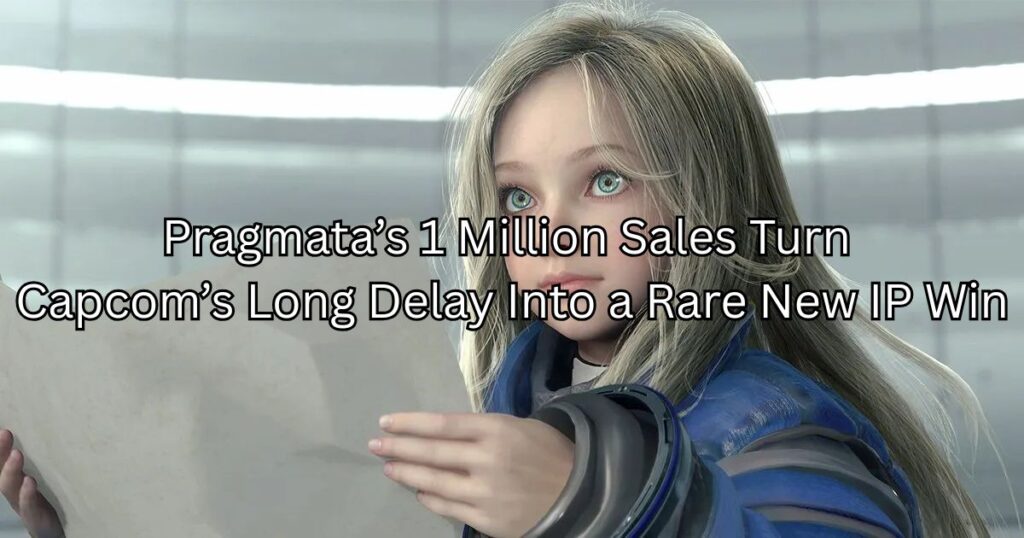
For most publishers, a six-year development cycle on an unproven sci-fi game would be treated as a warning sign. For Capcom, Pragmata has turned into something much harder to dismiss: a new intellectual property that sold more than 1 million units worldwide in just two days.
Capcom announced on April 20 that Pragmata had crossed the million-unit mark after launching on April 17, 2026 for PlayStation 5, Xbox Series X|S, and PC. The Nintendo Switch 2 version is listed for April 24 in Japan and other parts of Asia. For a game with no legacy audience, no decades-old brand name, and years of uncertainty behind it, that is a striking start.
A Long-Delayed Game Finally Lands
Pragmata was never a safe bet. It was first announced in 2020, when the industry was still selling the promise of a new console generation. Then came delays, long silences, and the familiar anxiety that surrounds any game that slips from “coming soon” into “maybe someday.”
That history matters because the launch result changes the story. What once looked like a troubled project now reads like one of Capcom’s more interesting gambles: a big-budget single-player game built around a new world, a new cast, and a combat system that asks players to shoot, hack, dodge, and solve under pressure.
Capcom describes Pragmata as a science-fiction action-adventure following Hugh Williams and Diana, an android girl, through a near-future lunar world. The company says the game was developed primarily by younger Capcom staff, who built its identity around a mix of action and puzzle elements rather than relying on an established franchise formula.
The Million-Sale Number Changes the Conversation
The sales milestone is not just a clean PR line. It gives Capcom something most major publishers say they want but rarely manage to build: a new IP with immediate commercial traction.
In an industry where sequels, remakes, and live-service bets dominate release calendars, Pragmata arriving this strongly gives Capcom room to talk about the game as more than a one-off experiment. PC Gamer reported that Capcom USA COO Rob Dyer suggested the title could have a future within Capcom’s broader franchise lineup, though no sequel has been announced.
That distinction matters. A million sales in two days does not automatically create a franchise. It does, however, buy time, attention, and internal leverage. For a project that spent years looking like a question mark, Pragmata now has the one thing every new game needs inside a large publisher: proof that players showed up.
Why Players Responded
Part of Pragmata’s success appears to come from how unlike a modern corporate compromise it is. It is not another open-world checklist. It is not built around endless seasonal content. It is not asking players to treat a game like a second job.
Instead, its pitch is focused: a sci-fi action game with a hacking twist, anchored by the relationship between Hugh and Diana. GameSpot’s review called it an excellent shooter with strategic depth, highlighting the way its hacking mechanic adds tension to combat encounters.
That critical response helped shape the early conversation. TheGamer’s review positioned Pragmata as a warm, character-driven sci-fi adventure, while review roundups pointed to strong aggregate scores around launch.
The result is a game that benefited from both curiosity and relief. Curiosity because Capcom had kept its strangest new project alive for years. Relief because, after all that waiting, the game was not just real. It was good enough for players to recommend.
Capcom’s Patience Paid Off, but It Also Raises the Stakes
Capcom’s official explanation credits several factors behind the launch momentum, including its playable demo strategy, multi-platform planning, and the decision to bring the game to Nintendo Switch 2 early in the process. The company also emphasized that Pragmata had no existing fan base to lean on, which makes the sales result more meaningful.
That is the part worth watching. Publishers often say they want original ideas, but the business usually rewards familiar ones. Pragmata gives Capcom a counterexample. It suggests that a strange new single-player game can still break through when it has a clear hook, strong execution, and enough marketing runway to explain itself.
The risk now is what happens next. Capcom can treat Pragmata as the start of a new pillar, or it can overcorrect and rush the thing that made it work into a broader franchise machine. The difference between those two choices may decide whether Pragmata becomes a lasting series or a rare success story that was better left intact.
A Win for New Ideas, Not Just One Game
The easy takeaway is that Pragmata sold well. The more interesting one is that it sold well after doing almost everything the modern AAA market usually punishes. It took years. It disappeared. It launched as a new IP. It asked players to learn a strange combat rhythm instead of giving them a familiar power fantasy.
And still, 1 million people bought in within two days.
For Capcom, that is a commercial win. For players, it is a reminder that long development cycles do not always end in disaster. For the wider industry, it is something rarer: evidence that a publisher can survive the anxiety of waiting, protect a risky idea, and come out the other side with a new hit instead of another cautionary tale.

